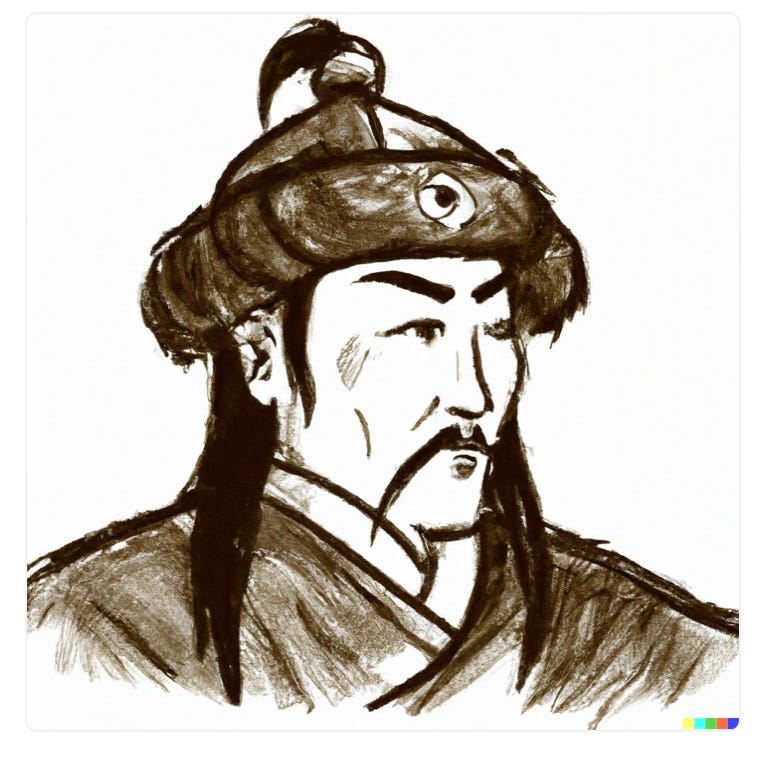
When you hear the name Genghis Khan, it often conjures up images of fierce Mongol warriors, thundering across vast landscapes, conquering all in their path. Born as Temujin around 1162, Genghis Khan rose from humble beginnings to become one of the most influential figures in history. He founded the Mongol Empire, the largest contiguous empire the world has ever seen. But what truly made him special?
- A Military Genius Ahead of His Time
Genghis Khan’s brilliance as a military strategist is undeniable. He transformed the Mongol army into an elite fighting force, mastering tactics that revolutionized warfare. His armies were known for their incredible speed, precision, and adaptability. He didn’t just rely on brute force—he used psychological warfare, deception, and intelligence networks to outmaneuver his enemies.
His ability to plan, execute, and win battles against seemingly insurmountable odds is a key reason his empire expanded so rapidly. From China to Europe, kingdoms and empires fell before his might, and his enemies often surrendered without a fight, knowing the terror of the Mongols’ military efficiency.
- Uniting the Mongol Tribes
Before Genghis Khan, the Mongol tribes were fragmented, constantly at war with each other. Temujin’s rise to power wasn’t just about his personal ambitions—it was about uniting his people. Through a combination of diplomacy, alliances, and warfare, he brought the warring tribes together under one banner, creating stability in a region long plagued by conflict.
This unity was not only crucial for his military conquests but also for fostering a sense of shared identity among the Mongols, laying the foundation for the empire that would soon follow.
- An Empire Built on More Than Just Conquest
While Genghis Khan is often remembered for his brutal military campaigns, his empire wasn’t just about war. He understood the importance of trade, communication, and cultural exchange. The Mongol Empire facilitated unprecedented movement along the Silk Road, connecting Asia, the Middle East, and Europe.
This era of relative peace, known as the Pax Mongolica, allowed for the exchange of goods, ideas, and innovations, shaping the future of global trade. Scholars, merchants, and artisans flourished under his rule, helping to create one of the most vibrant periods in history.
- A Champion of Religious Tolerance
One of the most remarkable aspects of Genghis Khan’s rule was his stance on religion. Unlike many leaders of his time, he promoted religious tolerance within his empire. Whether you practiced Buddhism, Islam, Christianity, or the traditional shamanistic beliefs of the Mongols, you were free to follow your faith without fear of persecution.
This tolerance helped create unity within his vast empire, where different ethnic and religious groups lived side by side. It was a rare and progressive approach for his era and contributed to the success of his governance.
- Legal Reforms and Justice for All
To maintain control over his vast empire, Genghis Khan implemented a set of laws known as the Yassa. This legal code ensured discipline and order within his ranks and among his subjects. It emphasized loyalty, unity, and respect for authority, helping to maintain stability across an empire that spanned from China to Europe.
His legal reforms extended beyond his military force. He fought against corruption and established a meritocratic system where people were promoted based on their abilities rather than their social status.
- A Legacy That Shaped the World
Genghis Khan’s influence didn’t end with his death. His descendants, particularly his grandsons like Kublai Khan, continued to build on his legacy, shaping the future of regions like China (under the Yuan Dynasty) and the Middle East. The Mongol Empire’s impact on world history is still felt today.
Under his rule, the world became more connected than ever before. Ideas and inventions, like printing and gunpowder, spread across continents. His empire also played a pivotal role in laying the groundwork for the modern world, including the globalization of trade and the exchange of cultures.
In Conclusion
Genghis Khan wasn’t just a warlord; he was a visionary leader who shaped the course of history. His military genius, efforts to unify the Mongol tribes, promotion of trade and cultural exchange, religious tolerance, and legal reforms all contributed to his lasting legacy.
Today, Genghis Khan stands not only as one of the world’s greatest conquerors but as a ruler whose influence on global history is undeniable. While his conquests were often brutal, his vision helped create a more connected and culturally rich world. And that’s why Genghis Khan remains one of the most special and intriguing figures in history.
 DREAMSONLINE
Leave a comment